

Enterprise Solution Areas:
The adoption of Enterprise Resource Planning (ERP) systems in the education sector is fundamentally transforming how institutions manage their operations, shifting from fragmented, paper-based processes to integrated digital environments. Our Education ERP is a comprehensive software suite designed to streamline core administrative functions, covering everything from student admissions and course scheduling to financial management and human resources. By centralizing data and automating workflows, these systems create a unified digital campus, significantly enhancing efficiency and transparency. This integration allows educators to spend less time on administrative tasks and more time focusing on student success, ultimately improving the overall learning experience. Furthermore, an effective Education ERP provides critical reporting and analytics capabilities, offering leadership the necessary insights to make data-driven decisions regarding resource allocation, curriculum planning, and institutional growth, making it an indispensable tool for modern educational excellence.
Key Features of the Product:
- 1. University/ Institutions Service Portal
- 2. Online Admission Management
- 3. Online Affiliation Management
- 4. Online Fee Collection directly in university accounts with multiple Payment Gateways
- 5. Student Life cycle Management System
- 6. Centralized Examination Control System
- 7. Administrative Modules
- 8. Analytical Dashboard / MIS
- 9. Online Research Mgmt
- 10. Online External Examiner Appointment system
- 11. Online Academic Record Verification
- 12. Integration with Lok Sewa Service
- 13. Third Party Integration / Email Gateways / SMS Gateways / PG Integration /
- 14. Technical Support / Help Desk / Call Center
The agriculture industry is increasingly turning to Enterprise Resource Planning (ERP) systems to navigate the complexities of modern farming, from managing fluctuating commodity prices to optimizing supply chains. An Agriculture ERP is a specialized software solution tailored to handle the unique challenges of the sector, including crop rotation planning, livestock tracking, equipment maintenance, and field-level inventory management. This technology integrates crucial operational data, providing a holistic view of the farming enterprise, allowing for better forecasting and risk mitigation. For instance, farmers can use the system to track input costs (seeds, fertilizer, labor) against projected yields, ensuring profitability. By enhancing traceability from "farm to fork," an Agriculture ERP not only improves operational efficiency and compliance with regulatory standards but also empowers farmers to maximize resource utilization and embrace precision agriculture techniques for a more sustainable and productive future.
In the highly competitive hotel industry, a robust Online Booking System (often integrated with or functioning as a core module of a Property Management System or ERP) is the lifeblood of revenue generation and guest experience management. This system provides a seamless, real-time interface for potential guests to check availability, compare rates, and secure reservations directly, bypassing costly third-party intermediaries. For the hotel, the integrated system centralizes all booking data, instantly updating room inventory across multiple distribution channels, preventing overbooking, and optimizing pricing strategies through dynamic revenue management. Beyond simple transaction processing, a sophisticated Online Booking System captures valuable guest data, enabling personalized communication and targeted marketing campaigns. Ultimately, its primary role is to ensure maximum occupancy and yield by offering a user-friendly, reliable booking experience that converts lookers into bookers and forms the crucial first touchpoint of a memorable stay.
The transport and logistics industry, characterized by intricate scheduling, high capital assets, and complex regulatory compliance, relies heavily on Enterprise Resource Planning (ERP) systems to maintain profitability and operational control. A Transport ERP is an integrated platform designed to manage the entire movement lifecycle, from order entry and freight planning to fleet maintenance and driver management. Key functions include route optimization to minimize fuel consumption, real-time tracking of goods and vehicles, and automated billing and invoicing. By consolidating data from various departments—such as warehousing, vehicle maintenance, and human resources—the system eliminates silos and provides a single source of truth for all operational metrics. This integration is crucial for improving on-time delivery rates, ensuring regulatory adherence (like driver hours of service), and ultimately enhancing supply chain visibility and customer satisfaction in a fast-paced, time-sensitive environment.
The dynamic and customer-centric tour and travel industry utilizes specialized Enterprise Resource Planning (ERP) systems to manage the complex orchestration of itineraries, bookings, and customer relationship management. A Travel ERP serves as a central hub for packaging various components—flights, accommodations, activities, and transfers—into custom or pre-defined tours, instantly calculating costs and generating quotes. Its most critical function is real-time inventory management, ensuring that tour operators can book services with vendors (hotels, airlines) without delay and reflect accurate availability to customers. Furthermore, the system automates back-office processes like vendor payments, commission tracking, and financial reconciliation, significantly reducing administrative overhead. By providing a 360-degree view of the customer, from inquiry to post-trip feedback, a robust Travel ERP empowers agencies to deliver highly personalized experiences, efficiently handle modifications, and scale their operations globally while maintaining profitability.
While not a traditional industrial ERP, the News Industry relies on sophisticated enterprise systems to manage the rapid and complex workflow involved in content creation, distribution, and monetization. This specialized ERP-like ecosystem integrates modules for newsroom management, encompassing story planning, journalist assignments, content editing, and multimedia asset management (MAM). Its core function is to streamline the transition of a story from concept to publication across multiple platforms—print, web, mobile, and social media—while maintaining version control and editorial standards. Critically, these systems also tie into the business side, managing subscription billing, advertising inventory (ad placement optimization), and royalty payments for syndicated content. In an era of instant information, the News Industry's enterprise system is vital for ensuring speed, accuracy, and efficient monetization, transforming a fast-paced editorial process into a structured, profitable content delivery machine.
A Management Information System (MIS) is a formalized system dedicated to providing management at all levels with timely and relevant information to support decision-making, coordination, control, analysis, and visualization. Far beyond simple data storage, an MIS actively processes, organizes, and reports on data collected from various internal and external sources, transforming raw facts into actionable insights. The fundamental purpose of an MIS is to improve organizational efficiency and effectiveness by ensuring that the right information reaches the right person at the right time. For a CEO, this might mean a dashboard summarizing key performance indicators (KPIs) like quarterly sales trends, while for a department manager, it might involve detailed reports on resource utilization. By offering structured, periodic reports and supporting ad-hoc queries, the MIS acts as the nervous system of an organization, enabling managers to identify problems, track performance against goals, and strategically plan for the future.
Accounting and Finance Management is the strategic process of planning, organizing, directing, and controlling the financial activities of an enterprise, encompassing everything from procurement and utilization of funds to their allocation across various operations. Its primary goal is to ensure that the organization has the necessary capital to meet its objectives, while simultaneously maximizing shareholder wealth. This discipline involves several key functions, including financial planning (forecasting capital requirements), capital budgeting (evaluating long-term investment projects), working capital management (optimizing cash flow and inventory), and risk assessment. Effective finance management is critical for the survival and growth of any business, providing the framework for sound fiscal decisions, ensuring compliance with financial regulations, and maintaining liquidity and solvency. It provides the financial roadmap that guides the organization toward sustainable profitability and long-term stability in a dynamic economic environment.
The Employee Service and Rule Book, often compiled in a comprehensive Employee Handbook, is an essential document that formalizes the mutual expectations, policies, and procedures governing the employment relationship within an organization. It serves as a foundational reference guide for all employees, clearly outlining their rights, responsibilities, and expected conduct in the workplace. This document typically covers critical areas such as company mission and culture, employment conditions, compensation and benefits, performance management standards, code of conduct, disciplinary procedures, and health and safety protocols. Beyond simply stating rules, the Employee Handbook is a vital tool for ensuring legal compliance, promoting a fair and consistent work environment, and communicating the organizational culture. By establishing clear boundaries and expectations, the Rule Book helps prevent misunderstandings, resolve disputes effectively, and fosters a professional and productive atmosphere for everyone.
Release Order Management is a crucial administrative process, particularly within industries like media, advertising, publishing, or logistics, that governs the formal authorization for a specific service or action to commence. A Release Order is a standardized document that details the scope, cost, and schedule for a defined piece of work, acting as a legally binding instruction to an internal department or an external vendor. In advertising, for instance, a Release Order formally authorizes a media house to run a specific advertisement in a newspaper or on a broadcast channel. The management process involves generating, tracking, approving, and reconciling these orders against the eventual invoice. Effective Release Order Management is vital for ensuring budget control, preventing unauthorized expenditures, ensuring proper resource allocation, and maintaining a clear audit trail for all transactional activities, thereby streamlining financial accountability and operational execution.
A Content Management System (CMS) is a software platform designed to help individuals and organizations create, manage, and publish digital content without requiring deep technical knowledge of programming or web development. CMS solutions simplify the entire website lifecycle—from content creation to archiving—by offering a user-friendly interface, structured content storage, and tools for collaboration. They enable multiple users to work on the same website with defined roles and permissions, ensuring efficient content updates and maintenance. A CMS typically includes features like:
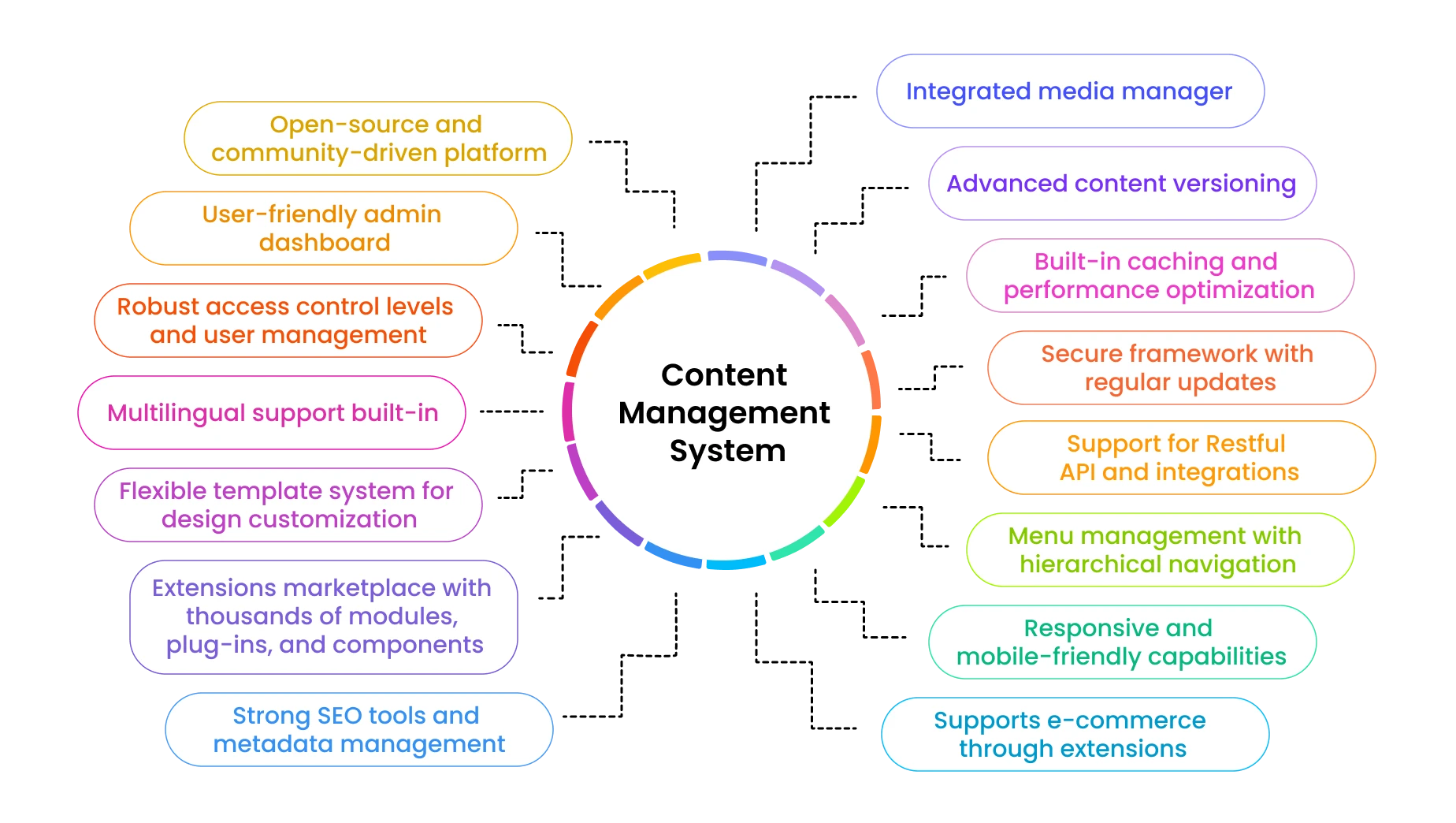
- 1. Open-source and community-driven platform
- 2. User-friendly admin dashboard
- 3. Robust access control levels and user management
- 4. Multilingual support built-in
- 5. Flexible template system for design customization
- 6. Extensions marketplace with thousands of modules, plugins, and components
- 7. Strong SEO tools and metadata management
- 8. Integrated media manager
- 9. Advanced content versioning
- 10. Built-in caching and performance optimization
- 11. Secure framework with regular updates
- 12. Support for RESTful API and integrations
- 13. Menu management with hierarchical navigation
- 14. Responsive and mobile-friendly capabilities
- 15. Supports e-commerce through extensions
Grievance Redressal System is a mechanism commonly used to receive and act on complaints or grievances reported by stakeholders of private or public institutions, enabling prompt actions on any issue raised by them and to avail services more effectively.
Why Grievance Redressal System?
When it comes to citizen services, Grievance redressal is necessary in all the organizations to investigate reason for the dissatisfaction of citizens and to obtain a speedy resolution to the raised problem. It also ensures that the grievances are resolved promptly and impartially with complete confidentiality.
In case of organizations, Grievance redressal is implemented to give employees and employers a fair and objective system to raise and review serious issues and complaints without bias. A formal grievance procedure should support employees to raise concerns relating to a safe working environment without the fear of any negative repercussions.
At the organizations’ level there are sometimes policy related grievances, which needs to be addressed and resolved for better and smoother operations of the organization.
CRISP Online System Grievance / Complaint Process Flow:
CRISP has successfully designed, developed and implemented a dynamic web based grievance redressal system which is deployed at many Government organizations and educational institutions.
Key Features of the Product:
- 1. Centralized dynamic web based solution
- 2. Online scrutiny , response on queries & completely paperless process
- 3. Rich User interface and Dashboard for stakeholders
- 4. Escalation Matrix of Online Grievance System
- 5. Analytical Reporting Services using BI
- 6. Status Tracking and Monitoring
- 7. SMS and Email Gateway Integration services